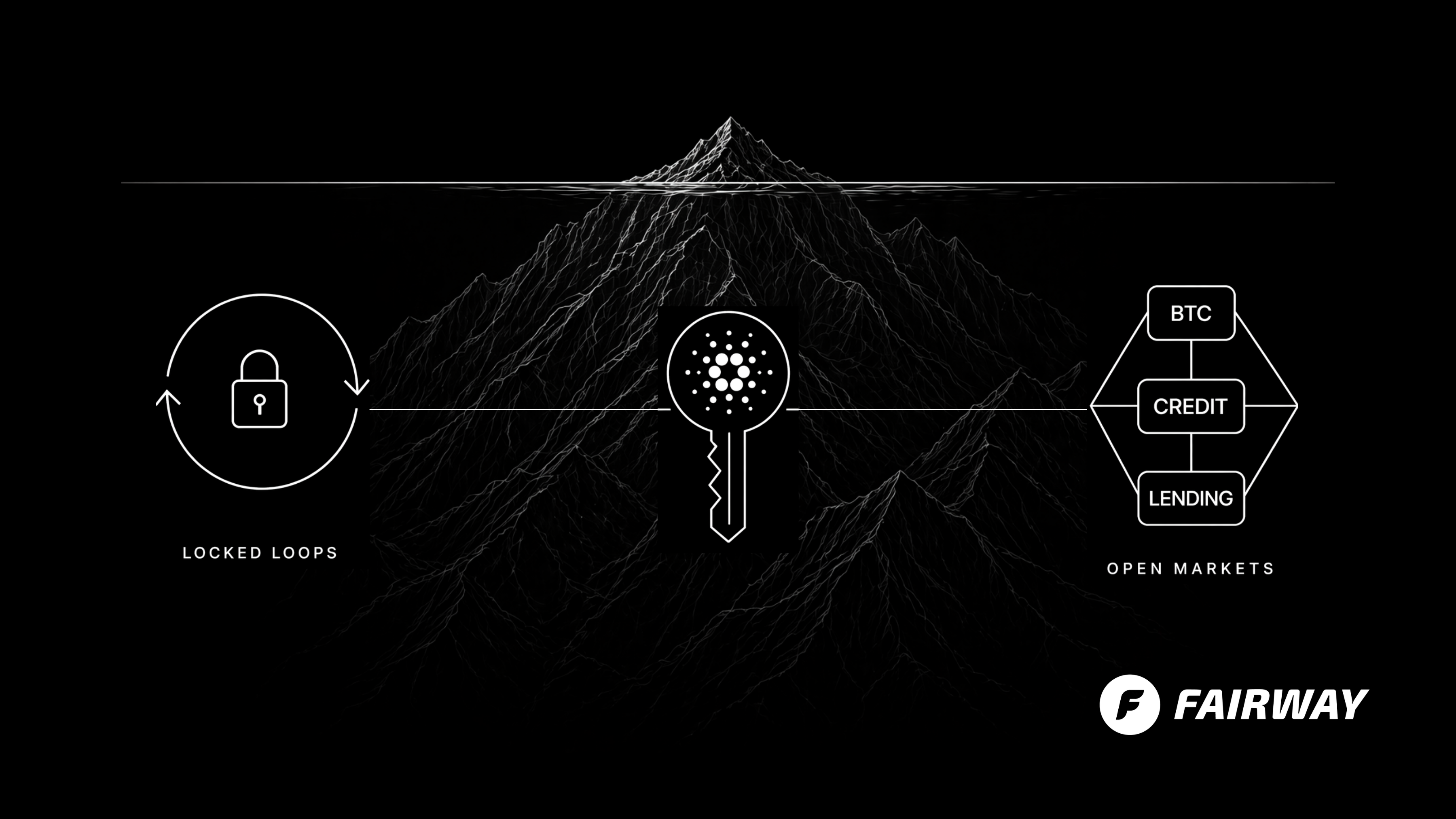
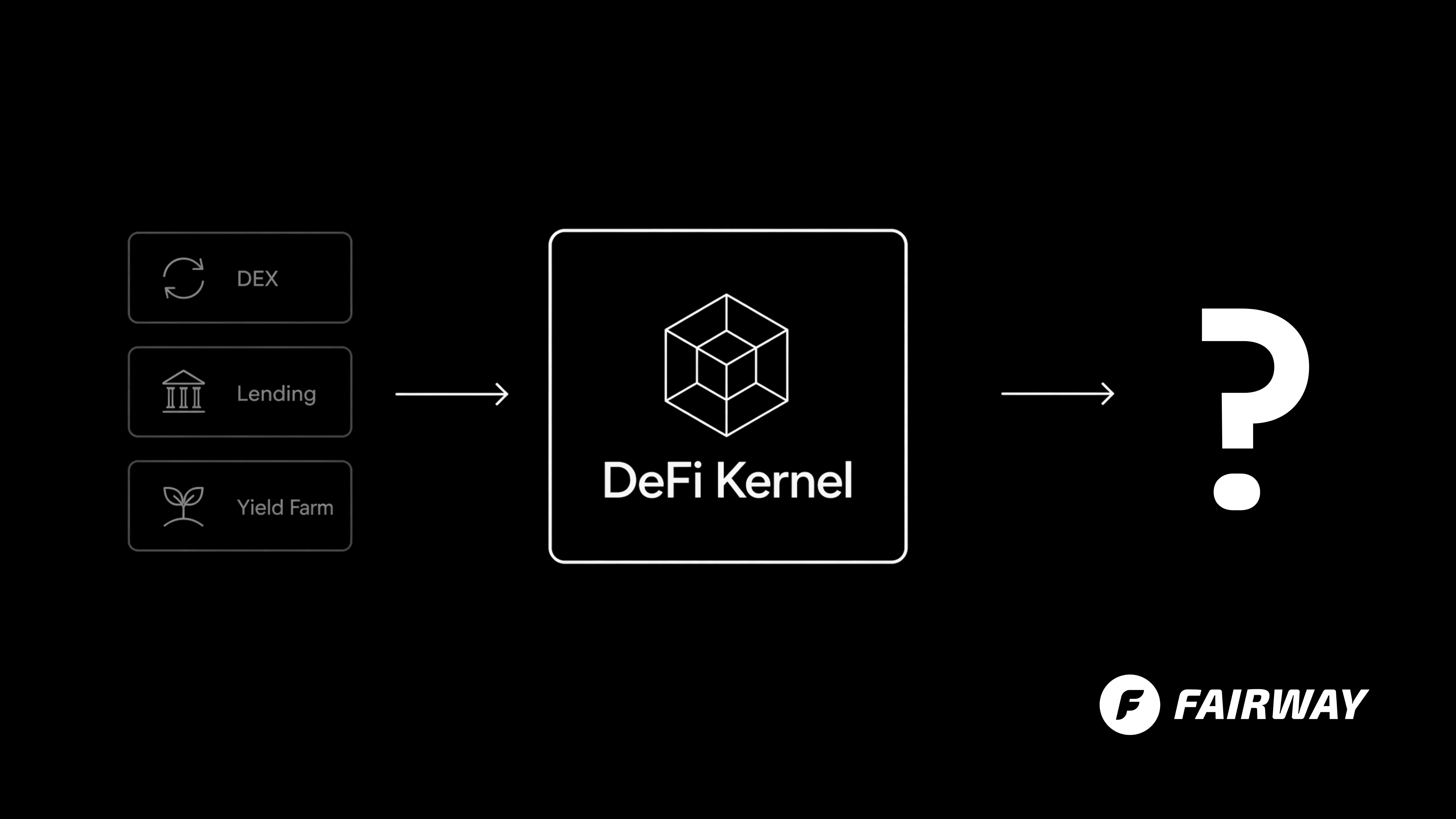
It's Time to Join Forces with TxPipe

At Fairway, we're building identity infrastructure for open financial systems.
In practice, that means creating tools that allow developers and institutions to use identity, credentials, and eligibility rules inside decentralized markets without exposing sensitive information on-chain.
Instead of putting personal data on public ledgers, Fairway uses verifiable credentials and zero-knowledge proofs so that smart contracts can verify things like:
- KYC status
- jurisdiction eligibility
- credit-related credentials
- signed agreements
All while keeping the underlying data private.
Our goal is simple: make identity feel like normal infrastructure for DeFi — something developers can plug into as easily as wallets or indexers.
That's particularly important for real-world asset (RWA) markets, where issuers often need to enforce eligibility rules around who can hold or interact with certain assets.
To do that in a way that institutions can actually operate, we started working with TxPipe.
Cardano Is a Natural Place for Credit and RWA Markets
Architecturally, Cardano has properties that make it particularly interesting for financial markets.
With eUTxO, you can model markets as shared state.
- A loan request can exist as a UTxO.
- A beacon token can mark it as an intent.
- Anyone can discover it and fill it.
That makes shared lending orderbooks possible directly on Layer 1, enabling peer-to-peer credit markets.
But the same architecture also works well for tokenized real-world assets.
With Cardano's native asset model and emerging standards like CIP-113 programmable tokens, assets themselves can carry logic about how they behave.
For example:
- who is allowed to hold them
- what credentials a holder must prove
- which jurisdictions they can move through
- what type of wallets or counterparties can interact with them
That kind of logic becomes much easier when identity and credential proofs are available as infrastructure.
Settlement alone isn't enough, though.
Markets for credit or RWAs also require:
- identity checks
- eligibility rules
- jurisdiction awareness
- counterparty validation
- coordinated transaction execution
Those layers shouldn't live inside consensus rules.
They belong to the infrastructure around the chain.
Identity Should Feel Like Wallet Infrastructure
For DeFi and RWA markets to work in real financial environments, identity cannot be a separate product every protocol has to rebuild.
It needs to feel like wallet infrastructure — a simple layer developers can tap into.
Fairway is designed to provide that layer.
Protocols should be able to plug into identity infrastructure for things like:
- KYC / identity verification
- credential-based eligibility rules
- RWA investor whitelists
- loan intent requirements
- zero-knowledge proof verification
- credit-related credentials
All without exposing personal data on-chain.
Midnight enables the private evaluation of credentials, while smart contracts verify the resulting proofs.
This means identity becomes a composable primitive, not a compliance database.
And for programmable tokens like those envisioned in CIP-113, identity proofs can become part of how those tokens enforce their rules.
Running the Infrastructure
This is where TxPipe Supernode becomes important.
Most DeFi stacks assume developers rely on shared infrastructure. But sometimes institutions want to run the full environment themselves.
With Supernode, institutional customers that want a safe identity layer for their DeFi operation can operate their own Cardano nodes and alongside it:
- their own indexers
- their own filtered APIs
- their own Fairway/midnight proof verification servers
- their own Fairway ID policy engines
Identity verification and proof generation can run within the same environment.
That allows Fairway identity services to become part of an institution's operational stack, not an external dependency.
It also allows identity infrastructure to run alongside the rest of the Cardano ecosystem — helping Fairway evolve into a decentralized service layer within Cardano infrastructure.
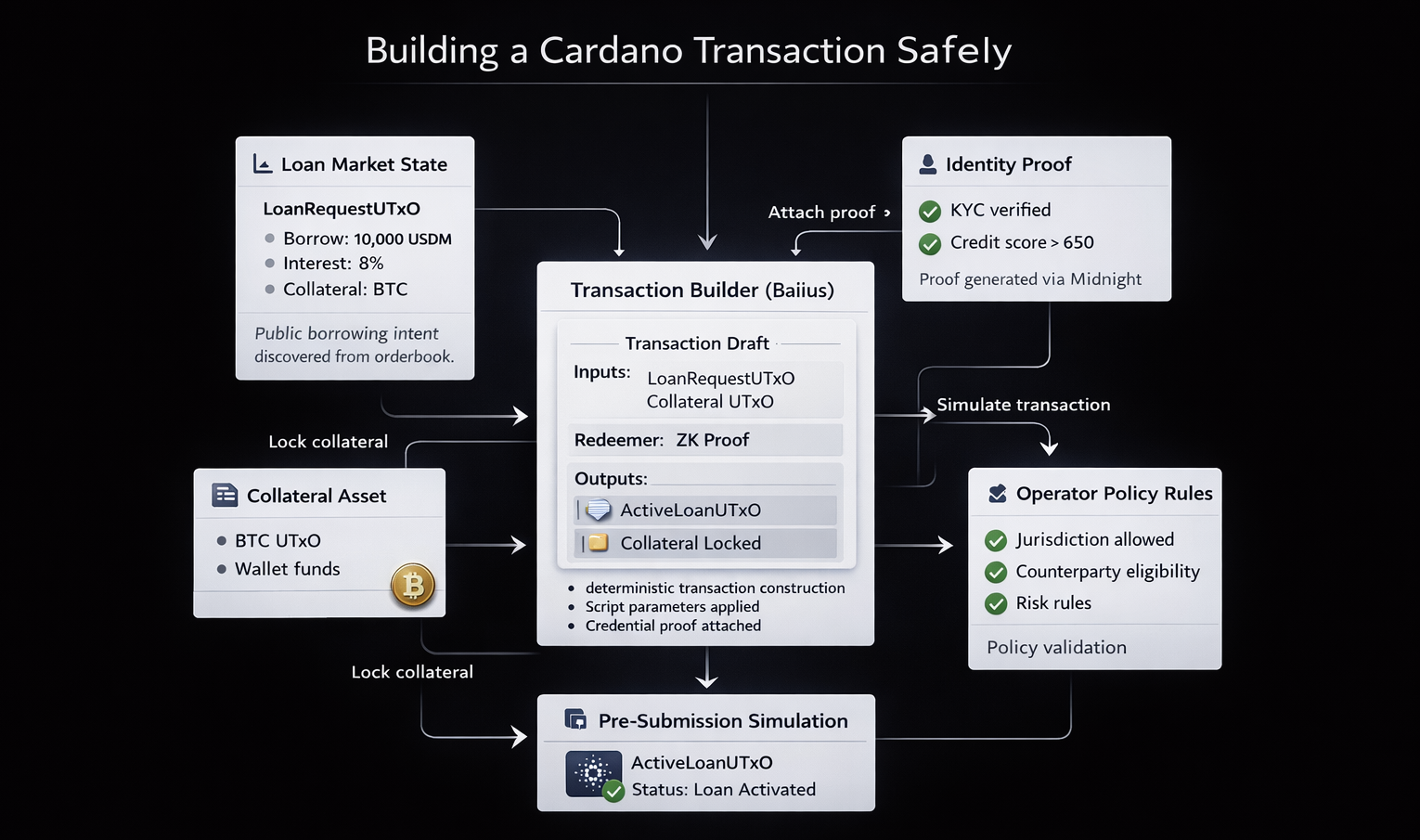
Building Transactions Safely
Under eUTxO, transactions must be fully specified before submission. Collateral, credentials, policies — everything must line up before the transaction reaches the chain.
If something is wrong, the transaction fails. In regulated markets, that's not just inconvenient: it's operational risk.
TxPipe Balius focuses on this construction layer.
It allows operators to:
- build transactions deterministically
- simulate them before submission
- enforce policy rules off-chain
- bundle complex flows into atomic operations
For RWA issuance or institutional credit flows, this kind of transaction reliability becomes critical.
Coordinating Credit and Asset Markets
Financial markets are inherently multi-party.
A borrower posts an intent → a lender evaluates it → an asset issuer defines eligibility → participants prove credentials → signatures must be coordinated.
This is where TX3 comes in.
TX3 organizes these interactions before settlement.
It helps participants:
- match loan or asset intents
- coordinate signatures
- assemble transactions
- simulate outcomes before submission
Cardano still enforces the final validity.
TX3 simply helps participants coordinate safely before touching Layer 1.
For RWA issuance and credit markets, this coordination layer becomes especially important.
Helping Fairway to Evolve
Working with TxPipe helps Fairway move beyond a standalone identity product, instead, identity becomes part of the Cardano infrastructure stack.
Developers building:
- lending markets
- credit pools
- RWA protocols
- programmable asset systems
- compliant DeFi applications
should be able to plug into identity and credential logic just as easily as they plug into wallets or indexers.
This collaboration helps make that possible.
Not by turning Cardano into a permissioned network.
But by making identity, infrastructure, and coordination operable within an open system.
The Goal
The goal isn't to add compliance to DeFi.
The goal is to make it possible for real financial markets to exist on-chain, where:
- Credited orderbooks live on Cardano
- programmable assets carry rules
- identity remains private
- proofs enforce eligibility
- institutions run their own infrastructure
- developers can easily build on top
If identity becomes a standard toolkit inside Cardano infrastructure, it unlocks entirely new markets.
That's the direction we're building toward.
Henrik Metsämäki
Expert in blockchain compliance and regulatory frameworks. Passionate about bridging traditional finance with decentralized technologies.